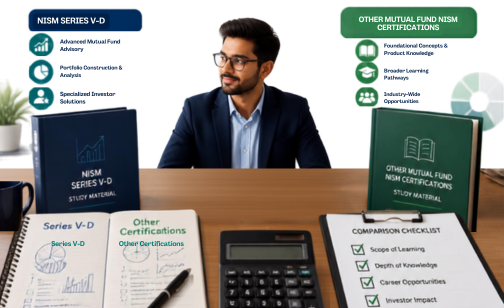
NISM offers several certification examinations related to mutual funds, but they are not designed for exactly the same purpose. For someone planning a career in mutual fund distribution—or looking to build knowledge of newer products such as Specialized Investment Funds (SIFs)—understanding these differences can make exam selection much easier.
The NISM Series V-D: Mutual Fund – Specialized Investment Fund Distributors Certification Examination is the newest addition to the mutual-fund certification landscape, having been made available from 22 July 2026. It covers mutual funds and SIFs while also introducing candidates to equity derivatives and interest-rate derivatives.
So, how does Series V-D differ from certifications such as Series V-A, V-B and V-C?
NISM Series V-A: Mutual Fund Distributors
The NISM Series V-A: Mutual Fund Distributors Certification Examination is focused on the fundamentals of mutual funds and their distribution.
Its objectives include understanding mutual fund concepts, scheme types, distribution practices, evaluation of schemes, legalities, accounting, valuation, taxation and financial planning. It is also the specified certification standard for persons involved in selling and distributing mutual fund products.
The current assessment consists of 100 questions carrying 100 marks, with a duration of 2 hours. The passing score is 50%, and there is no negative marking.
For someone primarily interested in the conventional mutual fund distribution ecosystem, Series V-A provides the core certification framework.
NISM Series V-B: Mutual Fund Foundation
The NISM Series V-B: Mutual Fund Foundation Certification Examination is designed for a specific category of distributors, including certain postal agents, retired government officials, retired teachers, retired bank officers and other similar persons notified by AMFI/AMCs.
The curriculum covers fundamental concepts such as mutual funds, different types of schemes, investment objectives, basic financial planning and distribution-related rules.
The examination has 50 questions for 50 marks, with a 2-hour duration, a 50% passing score and no negative marking.
This makes Series V-B different in both its intended audience and scope from the broader Series V-A examination.
NISM Series V-C: Mutual Fund Distributors Level 2
Series V-C is positioned as a higher-level examination for candidates who want to assess themselves against a higher standard of knowledge relating to mutual fund sales, distribution and advisory functions.
NISM describes it as a voluntary examination and advises candidates to pass Series V-A before attempting the Level 2 examination.
Therefore, V-C should not simply be viewed as another alternative to V-A. It represents a higher level of mutual-fund knowledge for candidates seeking additional depth in the area.
Where Does NISM Series V-D Fit In?
Series V-D is different because its scope combines mutual fund distribution with Specialized Investment Funds and derivatives-related concepts.
According to NISM's current objectives, candidates are expected to understand mutual fund fundamentals, distribution, product evaluation and suitability, as well as the basics of the Indian equity derivatives market. The syllabus also covers futures and options strategies and interest-rate derivatives.
This gives Series V-D a broader subject mix than a certification focused only on conventional mutual fund distribution.
The examination contains 150 multiple-choice questions carrying 150 marks, to be completed in 3 hours. The passing requirement is 60%, or 90 marks, and there is 10% negative marking for a question. The certificate is valid for three years.
A Simple Comparison

Exam details can change. Candidates should verify the latest information on the official NISM website before registration.
Which Certification Should You Prepare For?
The right certification depends on what you want to learn and the role you are preparing for.
If your focus is mutual fund distribution, Series V-A is the relevant certification to understand. If you fall within the specified category for the Mutual Fund Foundation examination, Series V-B addresses that foundational requirement.
Candidates looking for a higher-level understanding of mutual fund sales, distribution and related functions can explore Series V-C.
Series V-D is particularly relevant to those whose work involves the distribution of Mutual Fund and Specialized Investment Fund products, as its curriculum goes beyond traditional mutual fund concepts and includes equity and interest-rate derivatives. NISM states that the examination serves as the requisite standard for associated persons involved in the sale and distribution of Mutual Fund and SIF products.
Don't Prepare for Series V-D Like a Basic Mutual Fund Exam
One important point for Series V-D candidates is the breadth of the syllabus.
The curriculum begins with investment fundamentals, mutual fund concepts, legal structure and distribution practices, but also covers areas such as risk profiling, asset allocation, scheme evaluation, derivatives, futures and options strategies, fixed-income securities and interest-rate derivatives.
That means preparation should involve more than memorising definitions.
Candidates should understand concepts, revise regularly and practise questions that require them to apply what they have studied.
Practice Before You Appear
Whichever NISM certification you choose, practice can help you identify gaps before the actual examination.
For Series V-D in particular, candidates need to be comfortable with the 150-question, three-hour format and negative marking. NISM itself provides sample questions and worked examples in its workbook and also directs candidates to its mock-test facility.
A good practice routine can help you identify weaker topics, improve time management and become familiar with answering questions under exam conditions.
Choose the Certification That Matches Your Goal
NISM's mutual fund certifications serve different purposes. Series V-A focuses on mutual fund distribution, V-B provides a foundation for specified distributor categories, V-C offers a higher-level mutual fund examination, while V-D brings together mutual funds, SIF distribution and derivatives-related knowledge.
The important thing is not to choose a certification simply because it sounds more advanced. Understand the syllabus, eligibility or role requirements and the knowledge you actually need before deciding.
If you are preparing for NISM Series V-D, combining the official study material with regular practice and mock tests can help you approach the examination with a clearer understanding of both the syllabus and the test format.
Note: NISM examination structures, fees, curricula and regulatory requirements may be updated. Always refer to the latest official NISM information before registering for an examination.